
Working together helps communities tackle barriers in primary care
For the past year, CEAL’s Network for Community-Engaged Primary Care Research (NCPCR) program has funded Morehouse School of Medicine, OCHIN, and Health Choice Network to collaboratively conduct a randomized clinical trial, found on ClinicalTrials.gov, called CHW-SYSTIM. The study is looking at an intervention, led by community health workers (CHWs), to address social factors that make it harder for patients to control their diabetes and hypertension. CHWs in this study asked patients about social needs such as food, transportation, housing, and health care costs and then helped them connect with local resources to help address their needs.
To support the community health centers and CHWs in the study, the NCPCR program team held a CHW Learning Collaborative that met monthly from May 2025 to February 2026. Here, CHWs and the study team learned from one another in a supportive environment, sharing challenges and solutions to help adjust their strategies or approaches. Building on this foundation of collaboration and trust, these sessions ended with a series of three end-of-study meetings to capture key lessons learned with the study’s community health center partners.
To learn about the CHW Learning Collaborative, the End-of-Study Convening Series, and the resulting recommendations, we caught up with Anna Templeton and Anna Steeves-Reece, Investigators at OCHIN;* Johanna Gay, Study Champion and Outreach Manager at East Georgia Healthcare Center;* and Alexandra Hernandez, CHW at CommWell Health;* to gather their insights.
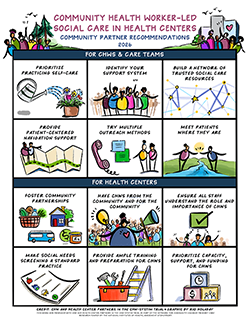
The CHW-SYSTIM End-of Study Convening Series iteratively produced a series of community partner recommendations for CHWs, care teams, and health centers wanting to integrate CHW-led social care into primary care. What are the key takeaways?
Templeton and Steeves-Reece: The meetings let us reflect on how to sustain and scale up CHW-led efforts within the bigger picture of usual care. Our recommendations for health centers highlight the importance of including CHWs into standard processes, offering them supports, championing their value, and centering community. The study reinforced our community partners’ recommendations to strengthen CHW networks and support so they can meet patients where they are.
Which of the recommendations for CHWs and care teams stands out as being the most relevant to your direct work with patients, and why?
Gay: Strong communication between CHWs and the care team is so important. When everyone works together and shares information, patients get better support. This helps make sure patients’ needs are understood and that they can get connected to the right services and resources.
Hernandez: I agree. Strengthening communication and collaboration between CHWs, patients, and the healthcare team is vital.
Which recommendation for health centers do you feel is most important?
Hernandez: Health centers can do their part to both support and fully integrate CHWs. For example, they can provide ongoing training and opportunities for professional development.
Gay: It is important for health centers to invest in CHW programs. CHWs play an important role in helping patients navigate the healthcare system and access community resources. Providing training, support, and stable funding helps CHWs be more effective in their work.
What insights or practices gained from CHW-SYSTIM do you hope to continue moving forward?
Gay: I hope to continue looking at the whole person level, not just their medical condition. Moving forward, I want to keep building strong relationships with patients, connecting them to helpful resources (such as transportation, housing, and access to food), and working closely with the care team to support better health outcomes.
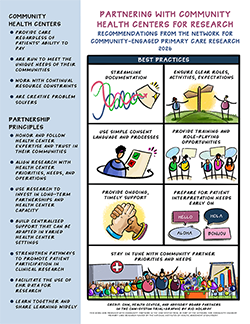
Hernandez: I hope CHWs and every member of the health care team continue working together to help patients overcome barriers such as transportation, medical costs, food insecurity, and safe housing so patients can achieve better health outcomes.
Templeton and Steeves-Reece: Through the convenings, we compiled a set of guiding principles and best practices for research teams working with CHCs as community partners. This unique resource can help researchers and CHCs work together to set up productive partnerships.
What was the key to the success of the CHW-SYSTIM End-of-Study Convening Series?
Templeton and Steeves-Reece: The series built from the relationships developed between the study team and participating health centers, particularly the CHW Learning Collaborative. We routinely sought feedback from our NCPCR Program Advisory Board — which included patients and community members, health center leaders, clinician researchers, and scientific advisors — about how to effectively support CHWs.
What advice do you have for community-engaged research teams wishing to establish their own CHW Learning Collaborative?
Templeton and Steeves-Reece: It’s important to identify a skilled facilitator, create a space that is interactive and supportive, and prioritize agenda items driven by CHW interests and needs. In our CHW Learning Collaborative, CHWs set the following group agreements:
- Let's cultivate a space of mutual support
- Let's practice active participation
- Let's try to focus on what we can control and influence
- We believe the wisdom is in the room
- We don't all have the same experiences
- What's said here stays here, but what's learned here leaves here
These guiding principles laid the groundwork for a productive, trusting space. We hope that sharing these learnings and recommendations will benefit other health centers and research teams doing similar work in the future.
Graphics were produced with CHW, health center, and advisory board partners in the CHW-SYSTIM trial and are copyrighted by Rio Holaday.
Download the Partnering with Community Health Centers for Research (PDF)
Download the Community Health Worker-Led Social Care in Health Centers: Community Partner Recommendations (PDF)

Top row (left to right): Johanna Gay, East Georgia Healthcare Center; Alexandra Hernandez, CommWell Health
Bottom row (left to right): Anna Steeves-Reece, OCHIN; Anna Templeton, OCHIN
Last updated: July 30, 2026