
CEAL Brings Community-Engaged Research Focus to APHA Annual Meeting
CEAL programs were front and center at the 2025 American Public Health Association (APHA) Annual Meeting & Expo, which took place in Washington, D.C., from November 2 to 5. The 4-day event featured 25 different presentations representing CEAL, covering findings, successes, and lessons learned in community-engaged research and spanning 9 CEAL research teams.
CEAL presentations and posters were integrated into the wide range of APHA focus program areas, from maternal and child health to aging, from food and nutrition to chronic diseases, and beyond. To name just a few: Speakers from Texas Tech University Health Sciences Center, a research team in CEAL’s IMPROVE-CIP program, explored the impacts of rurality on maternal health care, including on the diagnosis and management of preeclampsia. Members of the Missouri CEAL Regional Team shared an intervention to address the health effects of loneliness and social isolation in older adults. The American Indian, Alaska Native, Native Hawaiian, and Pacific Islander Enrichment Initiative spoke about its intervention to leverage traditional sources of resilience to support heart health in Native Alaskan Yup’ik communities.
A broad variety of research methodologies was also on display, showcasing the many ways CEAL teams apply rigorous methodological approaches to their community-engaged research projects. For example, the Alaska Alliance for Community Engagement (AK ACE), an ACE-PATH research team, shared how it adapted Q-Sort methodology to elicit local perspectives about the unique health challenges faced by rural Alaska Native people. Another participatory qualitative research method, Photovoice, was deployed by IMPROVE-CIP to capture the perspectives of those most heavily impacted by maternal health stressors. The Alabama CEAL Regional Team discussed its study to explore expanding physical activity interventions (Exercise Is Medicine) beyond individual, clinic-level settings to benefit the broader community. Not only did this research maintain scientific rigor while addressing local contexts, but it also produced a replicable framework for use by other research teams wanting to do the same.
The CEAL Technical Assistance Center (CETAC) hosted a roundtable discussion highlighting some of the ways that centering communities in interventions can better address the social determinants of health, chronic disease, maternal health, and primary care access compared to traditional, academic-only research. “CEAL teams have shown that doing intervention research in collaboration with communities can improve trust, relevance, and health outcomes,” says Vivian Towe, an epidemiologist, researcher, and presenter for the CETAC roundtable.
This year’s engagement marks the fourth year CEAL teams have disseminated their research findings to the public health community at APHA. To date, CEAL has involved more than 1,200 partners, about half of which are community-based organizations. The teams have published more than 240 articles in peer-reviewed publications, which have collectively been cited more than 2,600 times. Along the way, the research teams have brought to light some promising practices for conducting community-engaged research. These themes span the research life cycle, from building in time for meaningful community engagement from the start, to creating intentional structures to disseminate learnings with researchers and communities alike. Learnings like these, shared with researchers and public health practitioners through APHA 2025, showcase the promise of the CEAL research platform in addressing public health challenges through community-aligned solutions.
Want to learn more about CEAL research? CEAL releases scientific snapshots bimonthly. To learn more about CEAL research, subscribe to the Research Roundup newsletter by signing up on the CEAL website.
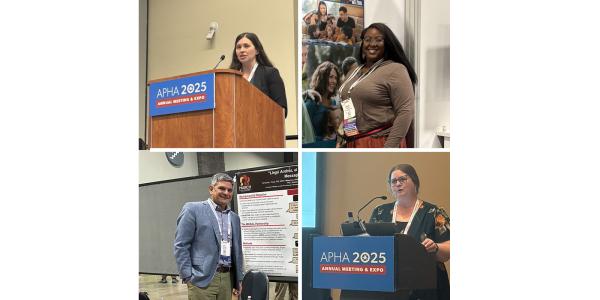
Top row (left to right): Katie Cueva (American Indian, Alaska Native, Native Hawaiian, and Pacific Islander Enrichment Initiative); Adlaide Holloway (Chicagoland CEAL Program and CEAL CBO Community of Practice)
Bottom row (left to right): Felix Valbuena (Michigan CEAL Regional Team); Cynthia Tiongco (IMPROVE-CIP)
Last updated: June 3, 2026